Cabo Verde’s Rainwater Systems: Are They Enough?

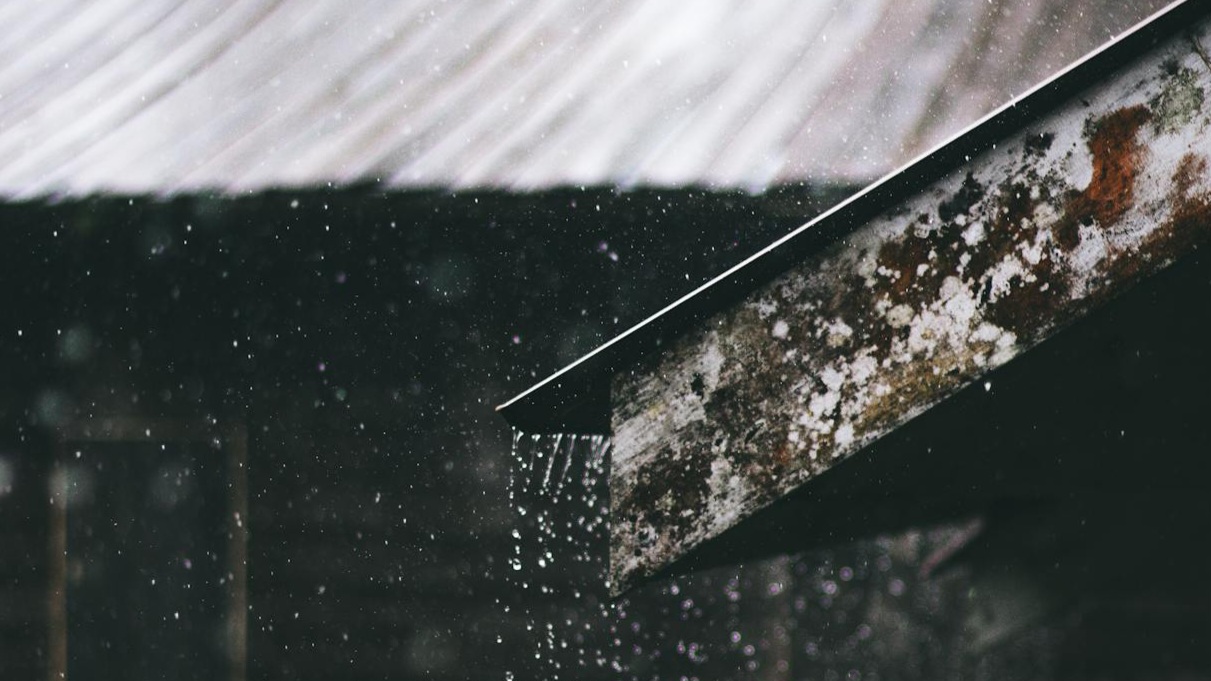
On the islands of Cabo Verde, fresh water is a scarce and valuable resource. With no large rivers or lakes and dry ground that makes digging wells difficult, the people rely heavily on rainwater to meet their daily needs. Rainfall is limited and comes mainly during a short rainy season, making water collection and storage critical for survival.
To address this challenge, many communities have developed rainwater harvesting systems that capture rain from rooftops and store it in tanks for use during dry periods. But the key question remains: are these rainwater systems sufficient to provide enough clean water for everyone in Cabo Verde? This article explores how rainwater is collected, why it is essential, and whether these systems can truly meet the islands’ water demands.
Where Is Cabo Verde and Why Is Water a Problem?
Cabo Verde is made up of ten small islands in the Atlantic Ocean. These islands look beautiful, with beaches, mountains, and small villages. But there is something missing: rivers and lakes. Unlike many places, Cabo Verde does not have big rivers or lakes to provide water.
The islands get most of their water from rain. But the rain does not come often. In fact, some parts of Cabo Verde get less than 100 millimeters of rain in a whole year, while the wettest mountain areas might get up to 900 millimeters. Most of the rain falls in just three or four months, from July to October. The rest of the year is very dry.
Because of this, water is precious. People have to find smart ways to catch and save every drop.
How Do Rainwater Systems Work?
Rainwater systems are simple but clever. When it rains, water falls on roofs or special surfaces. Gutters and pipes carry this water into tanks or big containers. The water is stored there until it is needed for drinking, cooking, washing, or watering plants.
Here’s how a basic rainwater system works:
- Catchment area: Usually a roof or a smooth surface where rain falls.
- Gutters and pipes: These move the rainwater from the catchment area to a storage tank.
- Storage tank: A big container, often made of plastic or concrete, that holds the water.
- Filter: Sometimes, a filter is used to remove dirt and leaves.
- Tap: People use a tap to get water from the tank when they need it.
These systems can be small, for one family, or big, for a whole village.
Why Is Rainwater So Important in Cabo Verde?
Rainwater is important because there are no big rivers or lakes. The ground is often too dry to dig wells, and the ocean water is salty and cannot be used unless it is cleaned in a special way called desalination, which uses a lot of energy and money.
Rainwater is free and does not need much energy to collect. It can be used for many things, like:
- Drinking and cooking (if it is clean)
- Washing clothes and dishes
- Watering gardens and farms
- Giving to animals
For many families, rainwater is the only way to get clean water close to home.
How Much Rainwater Can Cabo Verde Collect?
The amount of rainwater that can be collected depends on:
- How much it rains
- The size of the roof or catchment area
- The size of the storage tank
Let’s look at the facts:
- Most rain falls in just three or four months.
- Some areas get less than 100 millimeters of rain per year.
- The wettest places get up to 900 millimeters, but these are rare and high in the mountains.
If a family has a roof that is 50 square meters, and it rains 200 millimeters in a year, they could collect about 10,000 liters of water (if they catch every drop). But in the dry season, there might be no rain for months. This means the tanks must be big enough to store water for a long time.
Are Rainwater Systems Enough for Everyone?
The Good News
Rainwater systems help many people. In some villages, rainwater tanks mean families do not have to walk far to get water. They can collect water during the rainy months and use it in the dry months. Some farms use rainwater systems to grow food during the dry season.
The Challenges
But rainwater systems are not perfect. Here are some of the problems:
- Not enough rain: In very dry years, there is simply not enough rain to fill the tanks. Droughts can last for months or even years.
- Small tanks: Many families cannot afford big tanks, so their water runs out before the next rain comes.
- Dirty water: If the tanks are not cleaned, or if the water is not filtered, it can become dirty and unsafe to drink.
- Climate change: The weather is becoming more unpredictable. Sometimes, the rains do not come at all, or they come all at once and cause floods.
- Growing population: More people means more water is needed. Tourism also uses a lot of water, sometimes more than local families.
The Numbers
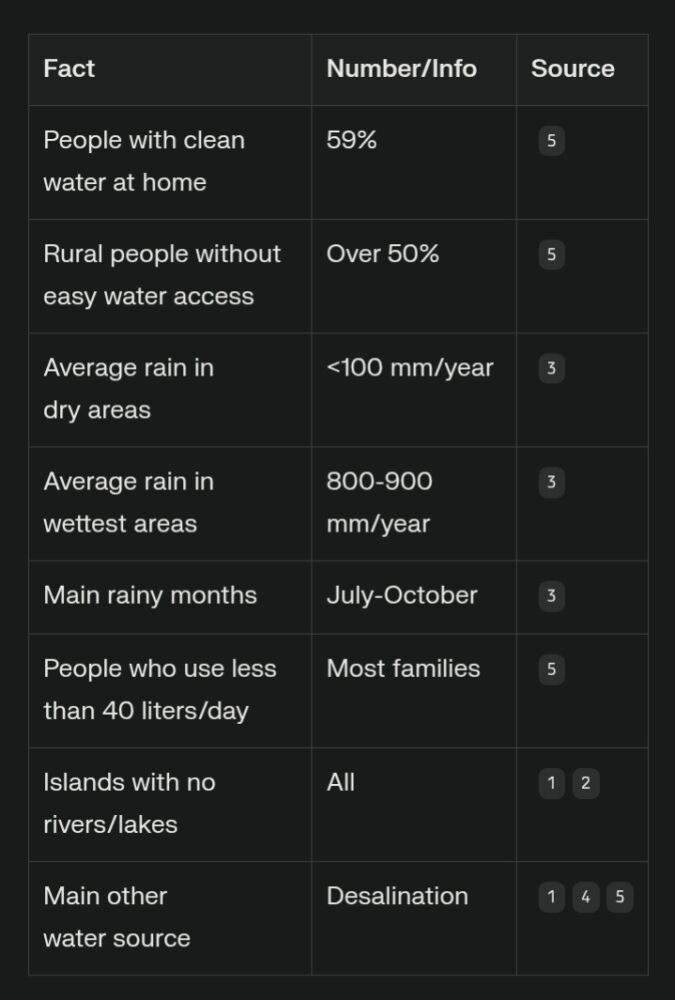
- Only about 59% of people in Cabo Verde have clean water in their homes or on their property.
- In rural areas, more than half of the people do not have easy access to clean water.
- Many families use less than 40 liters of water per person per day, which is much less than people in other countries.
- Some islands, like Sal, are even drier and depend almost completely on other sources, like desalination.
What Happens When Rainwater Is Not Enough?
When rainwater is not enough, people must find other ways to get water. Here are some of the main solutions:
- Desalination
This is a process where salt is removed from seawater to make it drinkable. Cabo Verde uses desalination more and more, especially in the cities and on the driest islands. But desalination needs a lot of energy, which makes water expensive. Most of the energy comes from imported oil, so prices can be very high.
- Water Trucks
In some places, water is brought in trucks and sold to families. This water is expensive, and not everyone can afford it.
- Dams and Reservoirs
Some islands have small dams to collect rainwater in big ponds. But because it rains so little, these often dry up quickly.
- Wells
There are a few wells, but the ground is often too dry, and the water can be salty or dirty.
How Are Rainwater Systems Being Improved?
People in Cabo Verde are always looking for ways to make rainwater systems better. Here are some ideas and actions:
- Bigger Tanks: Some projects help families get bigger tanks so they can store more water for the dry season.
- Better Filters: Using filters and teaching people how to keep tanks clean helps make the water safer to drink.
- Community Systems: In some villages, everyone shares a big rainwater system, so there is more water for all.
- Education: Teaching children and adults how to save water and keep it clean is very important.
- Support from Groups/NGOs: Non profit Organizations like Aqua Maya help provide access to clean water in these areas. Some NGOs help install rainwater systems and train people to use them well.
What About the Future?
Cabo Verde’s government and many groups are working hard to make sure everyone has enough water. They have made some progress:
- More people now have piped water and better toilets than before.
- New laws and programs help families get water more easily.
- There are plans to use more solar and wind energy to make desalination cheaper and better for the environment.
But there is still a long way to go. Climate change makes the weather even less predictable. More people and more tourists mean more water is needed every year.
Simple Ways Everyone Can Help
Even small actions can make a big difference:
- Fix leaks quickly so water is not wasted.
- Use a bucket instead of a hose to wash things.
- Collect rainwater in every home, even with a small tank.
- Teach friends and family about saving water.
Table: Cabo Verde Water Facts
Conclusion
Rainwater systems are a lifeline for many people in Cabo Verde. They help families catch and save water when it rains. But because the rain is rare and the dry season is long, these systems alone are not enough for everyone.
Cabo Verde needs a mix of solutions: rainwater systems, desalination, education, and support from NGOs like Aqua Maya. With teamwork, smart ideas, and care for every drop, Cabo Verde can move closer to a future where everyone has enough clean water.
Key Takeaways
- Rainwater is precious in Cabo Verde, but there is not enough for everyone all year.
- Rainwater systems help, but they need to be bigger, cleaner, and better managed.
- Other solutions like desalination and water trucks are needed, but they are expensive.
- Nonprofits like Aqua Maya play an important role in helping the local communities to access clean and safe water.
- Saving water and working together is the best way forward for Cabo Verde.
Every drop counts. By caring for water today, Cabo Verde can build a brighter, healthier tomorrow for all its children.
Sources
1. https://reportersonline.nl/cape-verdes-water-and-electricity-crisis-the-hidden-costs-of-development/
2. https://revolve.media/features/saving-water-in-dry-climates
3. https://www.scirp.org/journal/paperinformation?paperid=51778
4. https://www.elibrary.imf.org/view/journals/019/2024/040/article-A001-en.xml
5. https://borgenproject.org/sanitation-in-cape-verde/
6. https://reliefweb.int/report/cabo-verde/cabo-verde-dref-operation-final-report-no-mdrcv003
7. https://www.africanews.com/2024/05/27/cape-verde-bearing-the-brunt-of-the-effects-of-climate-change/
8. https://www.sciencedirect.com/science/article/abs/pii/S0016706114003474
9. https://edepot.wur.nl/218157